
Orbital now supports Scottish commercial real estate law


Orbital now supports Scottish commercial real estate work across title, searches, leases, offers and the PSG Certificate of Title. Purpose-built for Scots law, the capability was shaped through a structured pilot with Pinsent Masons.
Nearly £2bn of commercial property changed hands in Scotland last year, all of it under Scots law. Yet comparatively few legal technology platforms have functionality designed specifically for Scottish real estate practice.
For real estate teams working across the UK, that gap is practical and can result in differing approaches in cross-border transactions. A colleague in London can have a full suite of jurisdiction-specific AI tools, while the same job on a Scottish title can still be largely manual, with an associate working between the title sheet and a Word precedent.
Orbital has launched 22 workflows purpose-built for Scots law and Scottish real estate practice, tested and refined with real estate lawyers at several major UK firms.
“We have advocated for Scottish functionality since we first adopted Orbital. Our pilot team put considerable time into structured testing and feedback, and seeing that reflected in what has been launched is exactly the kind of collaboration we want with the technology we use. The Orbital team also worked closely alongside us to devise and deliver a well-executed plan for the Scottish rollout, providing responsive and practical support throughout the process. The result is the successful deployment of a tool that is increasingly tailored to the realities of Scottish property practice, accelerating our lawyers’ due diligence and reporting work whilst maintaining the commercial expertise, quality and consistency our clients expect.”
Sinead Hastings
Property Innovation & Change Team Lead and Legal Director, Pinsent Masons
Purpose-built for Scottish real estate work, not adapted from English workflows
Being able to read the underlying material is not the same as understanding the legal framework behind it. Pointing an English AI workflow at a Scottish document is therefore no real shortcut.
An English lease review may be looking for issues framed around English law when the Scottish lawyer needs it to consider concepts such as irritancy, rei interitus and common law repairing obligations. A title workflow built around the English system will not approach a Scottish title sheet or a Sasine title in the way Scottish property work requires.
The result is more work for the real estate lawyer: checking the substance of the AI-enabled output while also correcting assumptions that do not belong under Scots law. The efficiency gains AI promises quickly disappear.
Orbital’s Scottish workflows were developed around the documents Scottish real estate lawyers actually work with, the information they rely on and the questions they need answered. The work was led by Orbital’s Legal Engineer, Ruairidh McKillop, a dual-qualified commercial real estate solicitor, and is supported by a Scots law knowledge base with references to Scottish legislation and case law.
“Scottish property work has its own logic, and an English report cannot simply be patched into it. From rei interitus to the way Sasine titles and real burdens are treated, the underlying legal framework changes how the work needs to be done. We built the Scottish reports around that reality, then tested them with Scottish lawyers on real matters. That is the only way to get this right, and it reflects a conviction at the heart of Orbital: real estate needs technology built around the asset and the way the work is actually done.”
Ruairidh McKillop
Legal Engineer, Orbital
One connected platform across UK real estate work
The Scottish workflows sit inside the same Orbital platform firms already use for England and Wales work. Findings link back to the source material, so lawyers can see exactly where an answer came from and verify it against the underlying title, deed or lease. Review and approval workflows help teams work through a matter systematically, keep track of what has been checked and pick up where they left off.
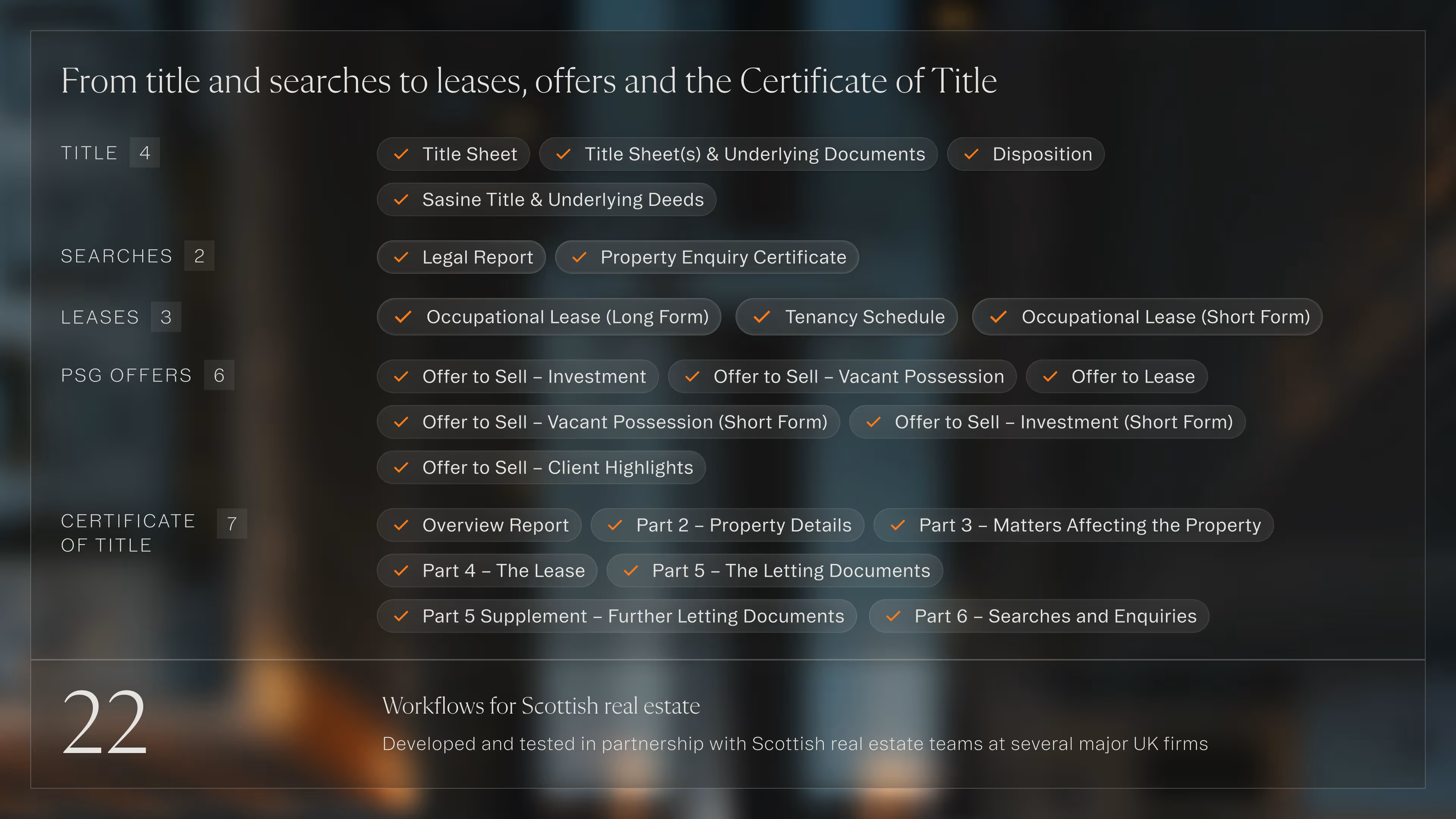
For real estate teams at organisations operating across the UK — from law firms and real estate businesses to corporate occupiers and lenders — that means the legal analysis can adapt to the jurisdiction without requiring a different way of working.
Every output remains a draft for review by a qualified lawyer, with the review process assisted by the platform’s verification tools.
Shaped by Scottish real estate lawyers
Pinsent Masons worked closely with Orbital to test and shape the new capability. Having asked for Scottish functionality since adopting Orbital, the firm’s Scottish team ran a structured pilot led by the Property Innovation & Change Team, with input from professional development lawyers and transactional lawyers in its property practice.
The purpose was to pressure-test the workflows against the reality of day-to-day Scottish property work: complex documents, different transaction types and the level of detail lawyers need from a report before they can rely on it as a starting point.
That feedback helped refine what launched.
For example, lease reports now quote the lease’s own wording where the precise drafting matters, rather than relying too heavily on paraphrase. Full repairing assessments make the component parts of the conclusion clearer, and reports review a full lease package holistically to identify matters from across the whole pack.
“On the comparison of a new lease style for a lease renewal as against an existing lease and preparing a comprehensive note for our client on the material differences, the first pass would normally have taken me a significant amount of time (given the different styles of leases). Using Orbital, that comes down dramatically. The biggest difference is being able to quickly identify and analyse substantive changes between the documents and produce a first draft of my advice because Orbital accelerates the initial analysis and allows me to establish the key issues more quickly. I can then focus my time on the points that need legal judgment.”
Katie Fallon
Senior Associate, Pinsent Masons
Other changes focused on how Scottish lawyers expect information to be presented and reviewed: tacit relocation is dealt with explicitly where relevant, terminology is consistent with Scottish practice, and title reports use clearer criteria for findings and a more consistent structure across multi-title packs.
These may sound like small details. In practice, they determine whether a report saves a lawyer time or creates another layer of checking.
Find out more
Learn more about how Orbital supports Scottish commercial real estate work here.
For existing Orbital customers, the new Scottish capability is included in their licence. Speak to your customer success manager about adding your Scottish users.
If you are new to Orbital, book a demo to see it in action.